Election Weekend in Yangon
In November 2015, my family and I travelled from Bangkok to Yangon to spend a weekend with family friends who were living there. Their children were friends with our children, and the trip had been arranged without any thought of Myanmar politics. It was only a few days before we left Bangkok that we realised our visit would coincide with Myanmar's general election on Sunday, 8 November.
We were delighted by the coincidence. We knew enough about Myanmar to understand that this was no ordinary election.
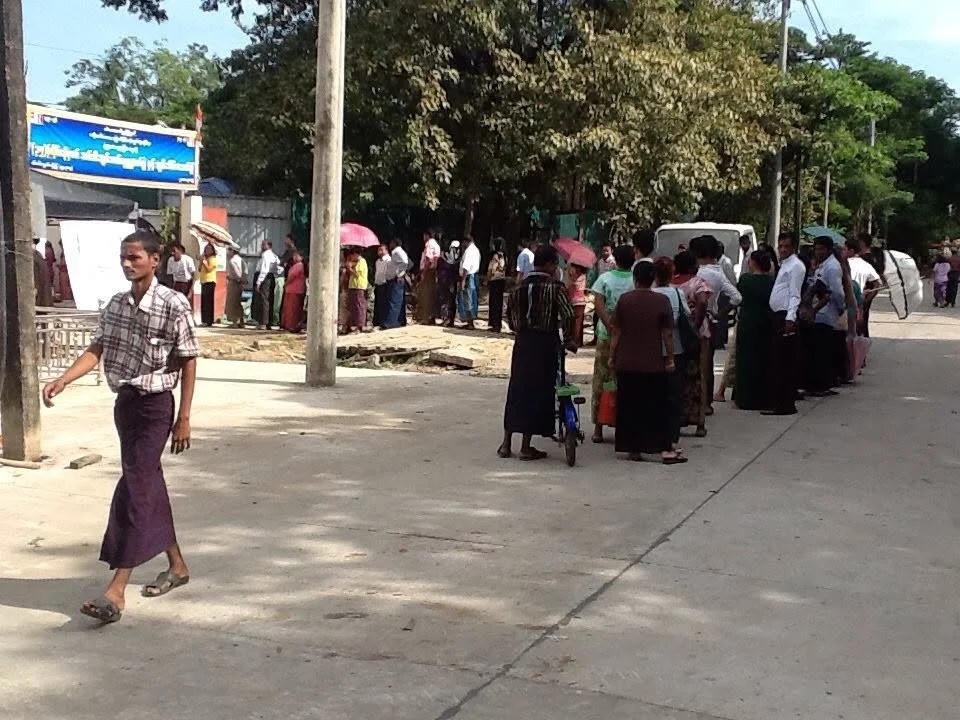
On Sunday morning, a group of us walked from our friends' home to a nearby polling station. Long before we reached the entrance, we came across the queue.
It stretched for more than a hundred metres.
What struck me immediately was not just the number of people waiting to vote, but the way many of them were dressed. People had made an effort. Some looked as though they were going to a wedding or some other important function. There was nothing sombre about the occasion. People talked and smiled as they waited.
More than anything, I remember the optimism.
There was a feeling that something important was happening and that the people standing in that queue were pleased to be part of it.
Contemporary accounts from Yangon recorded much the same scene. Voters began arriving before polling stations opened at six in the morning. Some had dressed in their best clothes. Long queues formed across the city as people waited to cast their ballots.
None of that seemed to diminish the enthusiasm we saw in Yangon that Sunday.
After visiting the polling station, we spent time walking around the city and later visited Shwedagon Pagoda. Everywhere we went there seemed to be the same festive atmosphere.
One image from that day has remained particularly clear in my memory.
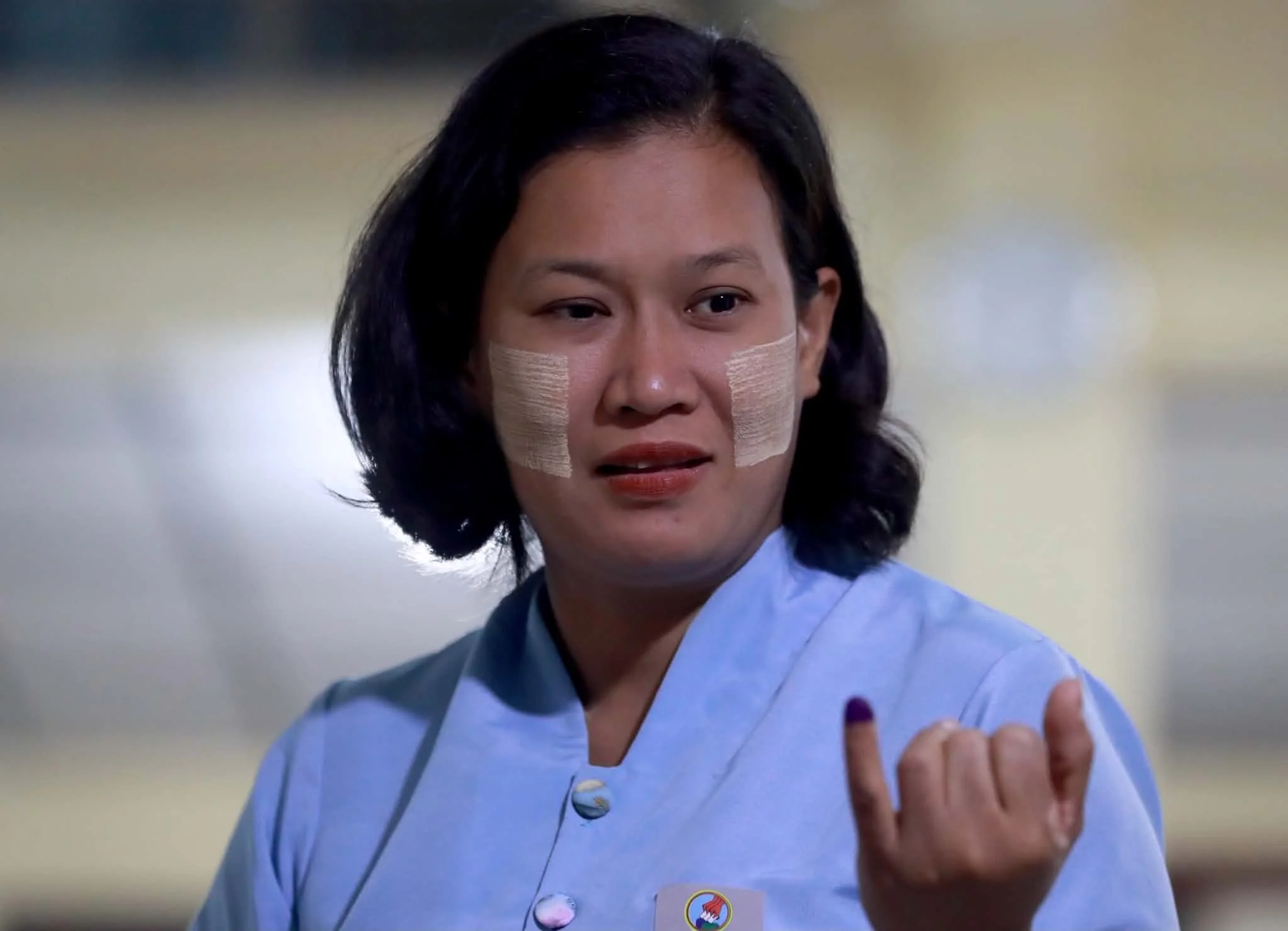
People were driving around Yangon with their hands extended from the windows of cars, holding up an ink-stained finger.
The ink was part of the voting procedure. After casting a ballot, a voter's finger was marked with indelible ink to prevent anyone voting twice. But on the streets of Yangon that day, the ink seemed to have acquired another purpose. People were displaying it proudly.
They had voted, and they wanted everyone to know it.
Photographs and reports from election day show exactly that phenomenon. Voters emerged from polling stations holding up purple stained fingers, sometimes smiling for cameras. Contemporary reporting described people raising their inked fingers almost as a sign of triumph.
It is difficult now, knowing what subsequently happened in Myanmar, to recreate completely the optimism of that weekend.
But it was very real.
Around 34.3 million people were registered for the election and almost twenty-four million voted, a turnout of just under 70 per cent. Ninety-one political parties contested seats in the lower house.
The election was also remarkably peaceful.
There had been plenty of reasons beforehand to worry that it might not be. Myanmar's political history offered little reassurance that the military would simply accept an opposition victory. There were also serious concerns about electoral rules, ethnic conflict and religious tensions.
For many of those voters, the occasion had been a very long time coming.
Myanmar had been dominated by its military since General Ne Win seized power in 1962. There had been an election in 1990, when Aung San Suu Kyi's National League for Democracy won an overwhelming victory, but the military refused to transfer power. Suu Kyi would spend much of the following two decades under house arrest.
The political landscape began to change after 2011 under President Thein Sein, himself a former general. Political prisoners were released, censorship was relaxed and the country began opening to the outside world. Suu Kyi was able to contest a parliamentary by election in 2012 and entered parliament.
By 2015, there was a genuine possibility that the NLD could win government.
But Myanmar was still a long way from being a conventional democracy. Under the 2008 Constitution, 25 per cent of the seats in parliament were reserved for serving military officers. That arrangement also gave the military an effective veto over constitutional change. Aung San Suu Kyi herself was constitutionally barred from becoming president.
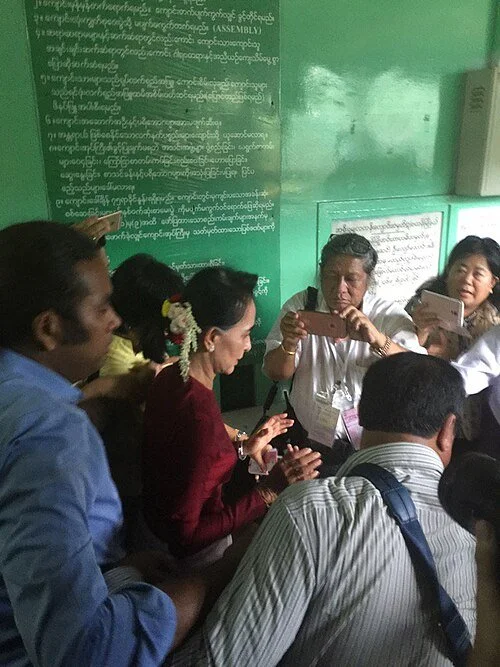
Aung San Suu Kyi arrives to cast her ballot in Myanmar's general election, 8 November 2015. Photograph: Steve Herman, Voice of America / Wikimedia Commons. Public domain.
Yet the voting we witnessed in Yangon was orderly and cheerful.
As Sunday progressed, that sense of anticipation began turning into celebration.
By evening, large crowds had gathered around the city. People were celebrating even though the result was not yet known. Near the NLD headquarters, contemporary reports described crowds filling the road, cheering and waving the party's red flags as the counting began.
My memory is less of any political speech or announcement than of the people themselves. There were crowds everywhere, and they were joyous, jubilant and cheerful.
Something had changed.
We left Yangon early the following morning, before the results were clear, and returned home to Bangkok.
Living in Bangkok gave events in Myanmar a particular immediacy. Myanmar was not some distant country whose politics occasionally appeared on the international news. It was next door. Thailand and Myanmar share a long border, and their histories, economies and people have been connected for centuries. We followed developments there closely.
Over the following days, we watched the election results come in.
The scale of the NLD victory became apparent.
In the elected seats of the lower house, the NLD won 255 seats compared with just 30 for the military aligned Union Solidarity and Development Party. The result was sufficient, together with its victories elsewhere in the national parliament, to give the NLD control of the incoming legislature despite the seats constitutionally reserved for the military.
The optimism we had witnessed in Yangon appeared to have been justified.
International observers were also broadly positive about the conduct of the election. The Carter Centre subsequently praised the commitment of Myanmar's people to the democratic process while noting the considerable structural obstacles that prevented the system from being fully democratic.
Those qualifications matter.
Not everyone in Myanmar was able to participate in the democratic moment we witnessed in Yangon. Specific groups, including the Rohingya, who had previously been able to vote were disenfranchised before the election. Other ethnic and religious minorities were affected, while voting was cancelled in some conflict areas. The military's guaranteed parliamentary representation remained untouched.
The election therefore did not suddenly transform Myanmar into a liberal democracy.
But neither does that diminish what happened in November 2015.
Millions of people voted. An opposition party that had been suppressed for decades overwhelmingly defeated the military backed governing party, and the result was allowed to stand.
For a time, it appeared that Myanmar might just have crossed a threshold.
Five years later, the NLD again won an overwhelming victory in the November 2020 election.
Then, on 1 February 2021, the military seized power.
Aung San Suu Kyi and other civilian leaders were detained and the country's brief experiment with civilian government came to an end. The years since have brought armed resistance, repression and a civil war that continues to inflict an enormous cost on the people of Myanmar.
That knowledge inevitably changes the way I remember the weekend I spent in Yangon in November 2015.
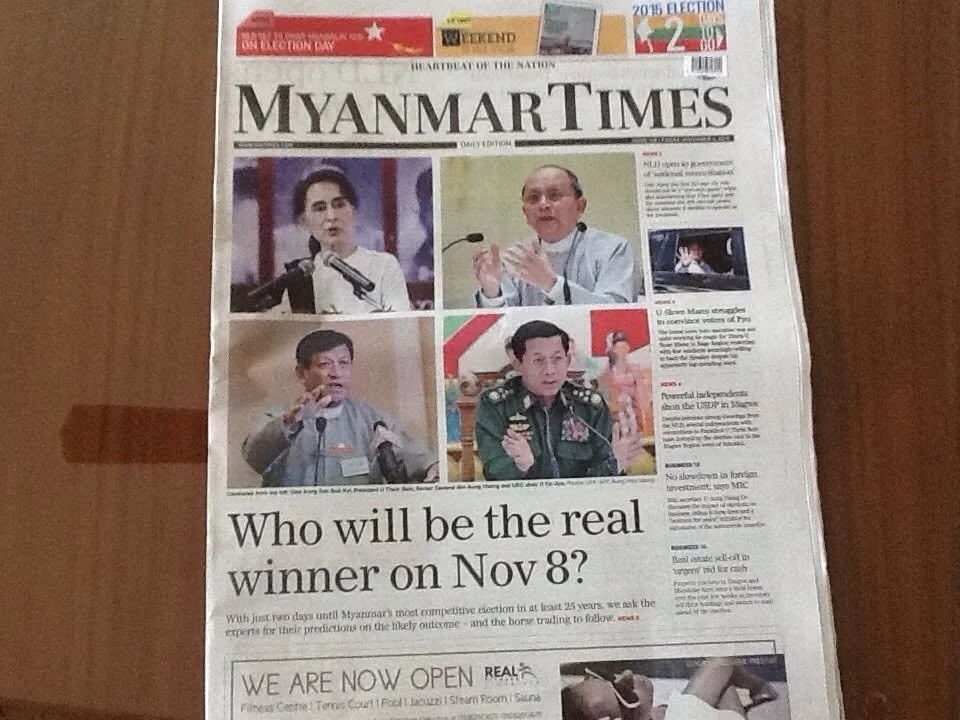
I still have a photograph I took of the front page of the Myanmar Times shortly before the vote. Four political figures appear on the front page beneath the headline:
Who will be the real winner on Nov 8?
At the time it was simply a newspaper headline anticipating an uncertain election.
Looking at it now, the question seems rather more significant.
But my strongest memories of that weekend are not of politicians.
I remember walking towards a polling station and discovering a queue stretching more than a hundred metres along the street. I remember how people had dressed for the occasion. I remember the crowds around Yangon and the atmosphere at Shwedagon. And I remember people passing us in cars, holding their hands outside the windows so that everyone could see the ink on their fingers.
We had travelled to Yangon simply to spend a weekend with friends and, quite by accident, found ourselves there on one of the most important days in the country's recent history.
More than a decade later, and knowing what has happened since, what stays with me most strongly is the optimism.
For that weekend at least, it seemed that the people of Myanmar believed the future of their country was finally theirs to decide.
Let’s hope that one day, it will happen.